
Energesis is testing the waters for a Regulation Crowdfunding offering on BioTech Funding Portal. Learn more →
Scientific rationale
Weight has two sides. We work on the one that no marketed drug addresses.
GLP-1 drugs proved obesity can be treated with medicine, but they work only on the energy intake side. They do nothing to stop the body from slowing its metabolism in response to weight loss. That slowdown, along with lost muscle, sets the stage for weight regain.
Energy balance
Energy intake vs. energy expenditure
Body weight reflects a balance between energy intake and energy expenditure. All presently marketed obesity drugs focus on reducing intake. Energesis is focused on the expenditure side of the body weight equation.
Brown fat, or BAT (brown adipose tissue), is specialized tissue that dissipates energy from sugars and fats as heat. Energesis is developing candidates intended to recruit new brown fat cells and restore a healthier level of energy expenditure.
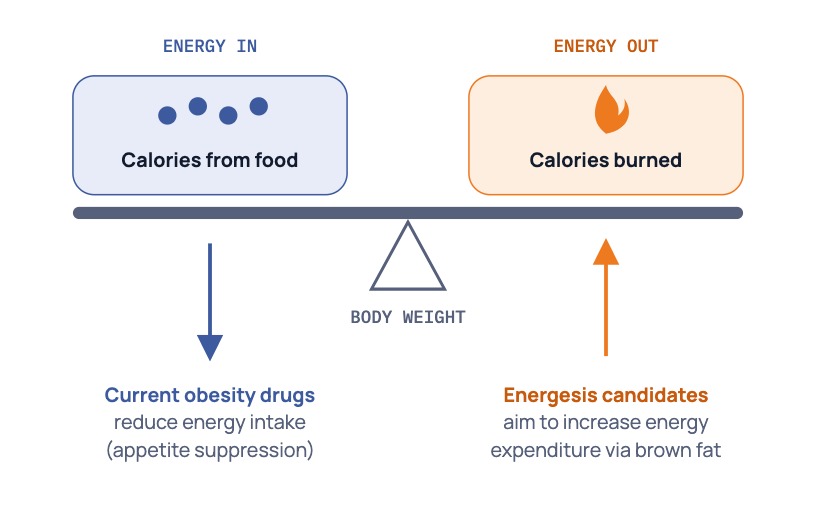
Illustrative conceptual graphic.
Brown fat biology
How brown fat works
Most body fat is white fat, which stores energy. Brown fat cells are unique in that they contain uncoupling protein-1 (UCP1). This lets their mitochondria release energy from sugars and fats as heat instead of storing it. Brown fat keeps us warm in the cold, and also functions to burn off excess calories.
Adults carry only about 50 to 400 grams of it, but it burns energy so fast that even a small amount affects how many calories the body burns at rest. PET/CT imaging shows that people with more brown fat tend to weigh less and have less body fat, with healthier blood sugar and better cardiovascular health.
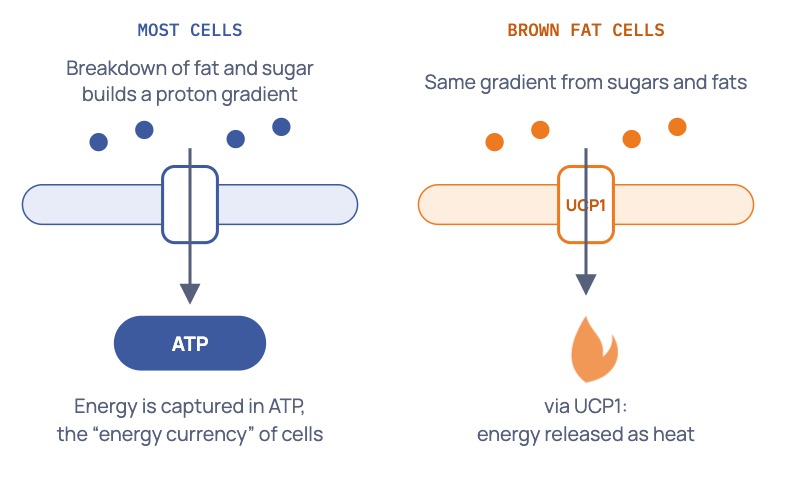
Simplified view of the mitochondrial inner membrane. Illustrative only.
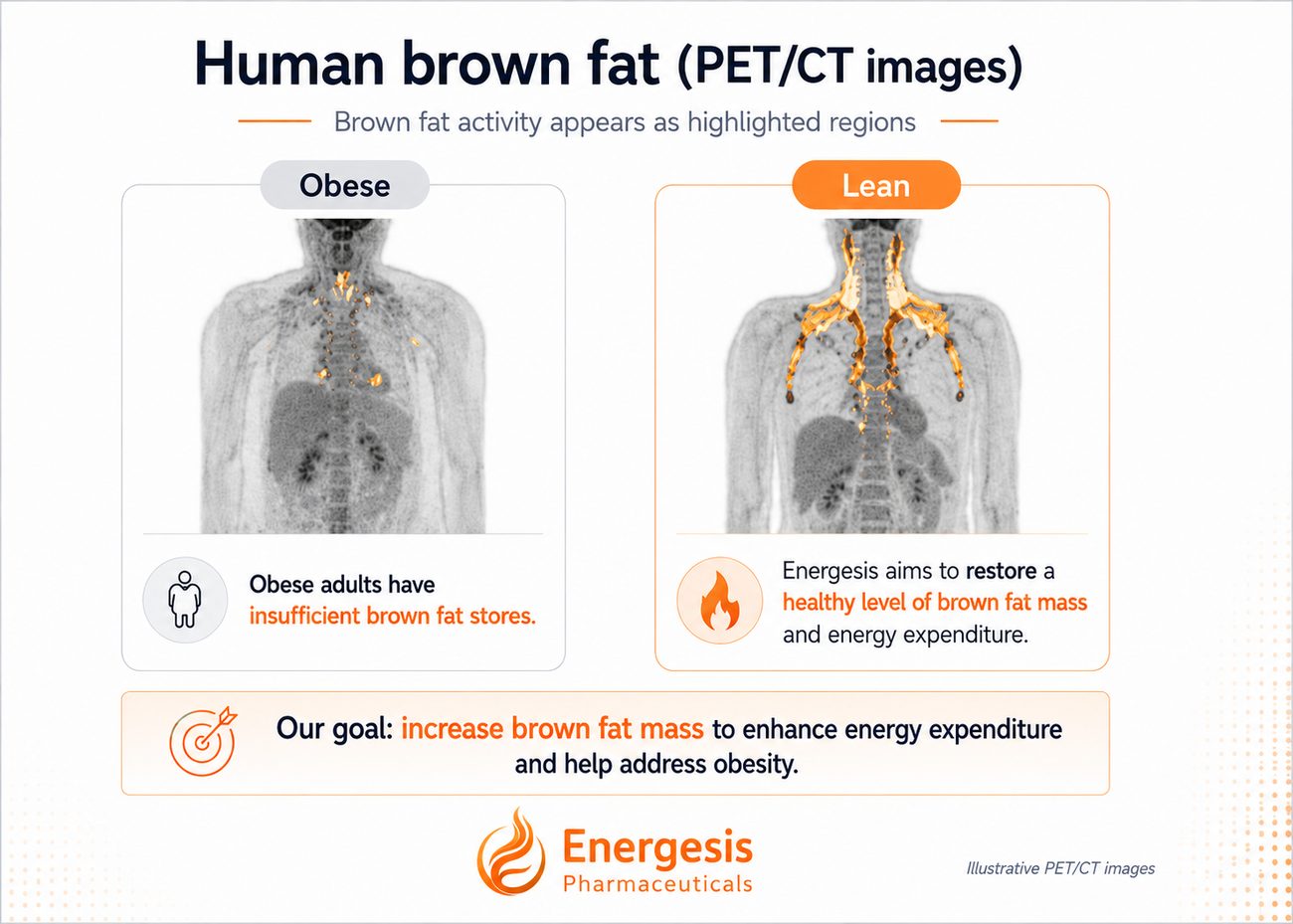
Illustrative PET/CT images. Brown fat activity appears as highlighted regions.
Human brown fat activity
Not switching on an insufficient mass of brown fat, but making more of it
Brown fat activity can be visualized in PET/CT images as highlighted regions. Obese individuals tend to have significantly less brown fat than lean people. By restoring a healthy level of brown fat and energy expenditure in obese individuals, Energesis is intending to promote normal weight and metabolic function.
Importantly, Energesis’ approach to brown fat is novel. In contrast to prior attempts to activate the limited brown fat that may already exist, the company’s product candidates are designed to create more brown adipocytes from adult human progenitor cells.
Why people with obesity have less
The ability to make new brown fat varies between people and declines with age. People with obesity generally have less brown fat than lean people. Research shows that the strongest genetic link to general human obesity, the FTO gene, seems to lead to obesity by impairing brown fat formation.
Why earlier approaches fell short
In the 1980s and 1990s, drugs were designed to stimulate existing brown fat. They had limited success for two reasons. People with obesity have too little brown fat for the drugs to act on, and the drugs also stimulated the heart, raising heart rate and blood pressure.
Our approach
Energesis’ candidates are designed to create more brown fat cells from adult human progenitor cells. The body then activates those cells naturally through cold, meals and daily rhythms. All of Energesis’ animal data was produced without a separate activating drug.
Lowering the weight the body defends
Cutting food intake makes the body defend its fat by slowing metabolism. Raising energy expenditure through brown fat appears, in animals, to lower the body’s weight set point, so the body defends a lower weight instead.
The unmet need
What GLP-1s leave unsolved
Muscle loss
More than 30% of weight lost on GLP-1s can be lean mass, including muscle. Muscle burns energy at rest and absorbs up to 80% of blood sugar after meals.
Weight regain
Weight often returns when treatment stops, and more so as fat rather than muscle.
Metabolic slowdown
Drugs that reduce appetite also lower metabolic rate, so weight loss plateaus and becomes harder to maintain.
Tolerability
Nausea, vomiting and other GI effects mean many patients cannot reach or stay on a full dose.
Delivery
Most leading options are injectables, and demand is shifting toward oral options.
Lean-mass figure: Beavers KM et al., Obesity 2025;33(2):225-237. Glucose figure: Merz KE, Thurmond DC, Compr Physiol 2020;10(3):785-809.
After years of stagnation, we are now experiencing enormous success in the pharmacological management of obesity based on GLP-1 drugs. However, while the efficacy of these anti-obesity medications is better than anything that came before them, there are growing concerns about the quality of the weight loss and the associated decrease in metabolic rate, which seems disproportionate in relationship to the weight loss. Therefore, the addition of medication protecting against a drop in energy expenditure would be most welcome.
Questions
Frequently asked questions
Is Energesis competing with GLP-1 drugs like semaglutide and tirzepatide?
In short: No. We do not view GLP-1s as competitors. Instead, we view them as complementary partners.
Body weight is governed by a simple balance: calories in versus calories out. GLP-1s target “calories in”: they work primarily by increasing feelings of fullness and suppressing appetite. Energesis targets “calories out”: our approach focuses on the other side of the body weight equation, increasing energy expenditure.
Because our mechanism increases calorie burn rather than suppressing appetite, our drug candidates can theoretically be paired with any GLP-1 or appetite-reducing therapy. In our preclinical animal studies, combining our lead candidate with a low dose of a GLP-1 significantly enhanced total weight loss compared to the GLP-1 alone, while preserving muscle mass.
What does “fat-selective weight loss” mean, and why does it matter?
Fat-selective weight loss means dropping excess fat while keeping muscle intact. Cutting calories, whether through a low-calorie diet or appetite-suppressing medications like GLP-1s, also causes the body to shed lean mass. While individual results vary, lean muscle accounts for roughly 30% of total weight lost during conventional calorie restriction.
Muscle is a primary driver of resting metabolic rate, plays a critical role in healthy glucose metabolism, and provides the strength needed for daily life. When weight returns, the body builds back fat several times faster than it rebuilds muscle, which can leave a patient with a higher body fat percentage than when they started.
In preclinical animal studies, approaches that increase energy expenditure by expanding active brown fat mass cause weight loss that comes from body fat, with no detectable loss of lean muscle.
Why repurpose already-approved drugs for obesity?
Previously approved drugs have already demonstrated safety and manageable side effects in human populations, which significantly reduces the risk of unexpected toxicity. The FDA’s 505(b)(2) pathway also allows a company to rely on existing clinical and scientific data, which can save years of clinical development and substantial cost.
EGS-2632 is a fixed-dose combination of two drugs that have been marketed globally for decades with excellent safety track records. This allows us to focus our resources primarily on demonstrating the safety and efficacy of the combination itself. In our preclinical models, neither drug alone approaches the weight-loss efficacy achieved by the combination.
Because EGS-2632 achieves significant weight loss at a fraction of each drug’s approved dose, and its combined effect is greater than the sum of its parts, the U.S. Patent and Trademark Office granted composition-of-matter and use claims for EGS-2632.
Can you actually increase the amount of brown fat in adults?
Yes. Brown fat is highly plastic, meaning it can expand or shrink based on demand. When the body needs more heat, it calls upon progenitor cells (adult stem cells) to build brand-new, fully functional brown fat cells.
Cold is the natural trigger. In one clinical study, participants who slept in a cool room (19°C / 66°F) for one month saw a nearly 40% increase in brown fat volume, which reversed when they slept in a warm room. Drugs such as mirabegron can also increase brown fat, but they stimulate beta-3 receptors, which raises heart rate and blood pressure.
Energesis has identified candidates that, in laboratory studies, prompt human brown fat progenitor cells to mature into brown fat cells without acting through the beta-3 pathway. Our researchers found these progenitor cells in all of the individuals studied, including adults up to 80 years old.
Why do people regain weight after stopping GLP-1 medications?
Major clinical trials show that after stopping these drugs, people regain an average of two-thirds of their lost weight within one year. This isn’t a failure of willpower.
When you lose weight by eating less, your body defends its “weight set point,” or adipostat. It turns up hunger, turns down fullness and slows metabolism, and studies show GLP-1 medications lower resting metabolic rate. Because weight lost on GLP-1s includes muscle, and the body rebuilds fat first, regained weight can come back as mostly fat.
Because the set point is tied to how much energy the body burns, increasing energy expenditure may help lower it. In our lab studies, combining GLP-1-based weight loss with EGS-2632 produced much greater weight loss than GLP-1 treatment alone, and the weight loss was sustained for a prolonged period after dosing stopped.
How is Energesis’ approach different from earlier brown fat treatments that failed to translate in humans?
In the 1990s, researchers tried to “wake up” existing brown fat. This worked in lab mice, which carry a large amount of brown fat, but failed in humans, who have very little, and people with obesity even less.
In the 2000s, a protein called FGF21 increased brown fat mass in humans and led to significant weight loss, but it caused bone loss, so development was stopped. It proved that if you safely increase brown fat mass in humans, they lose weight.
Energesis aims to build up the body’s baseline reservoir of brown fat, which the body then activates on its own, such as after eating, during exercise, in the cold or during sleep. We are using oral drugs that are already proven safe in humans to increase brown fat mass.
Has EGS-2632 been tested in people?
No. Energesis’ programs, including EGS-2632, are in preclinical development. They have been evaluated only in laboratory and animal models, and preclinical results may not predict human safety or efficacy.
Why an oral medicine?
EGS-2632 is being developed as an oral candidate. A small molecule approach also offers straightforward, easily scalable manufacturing.